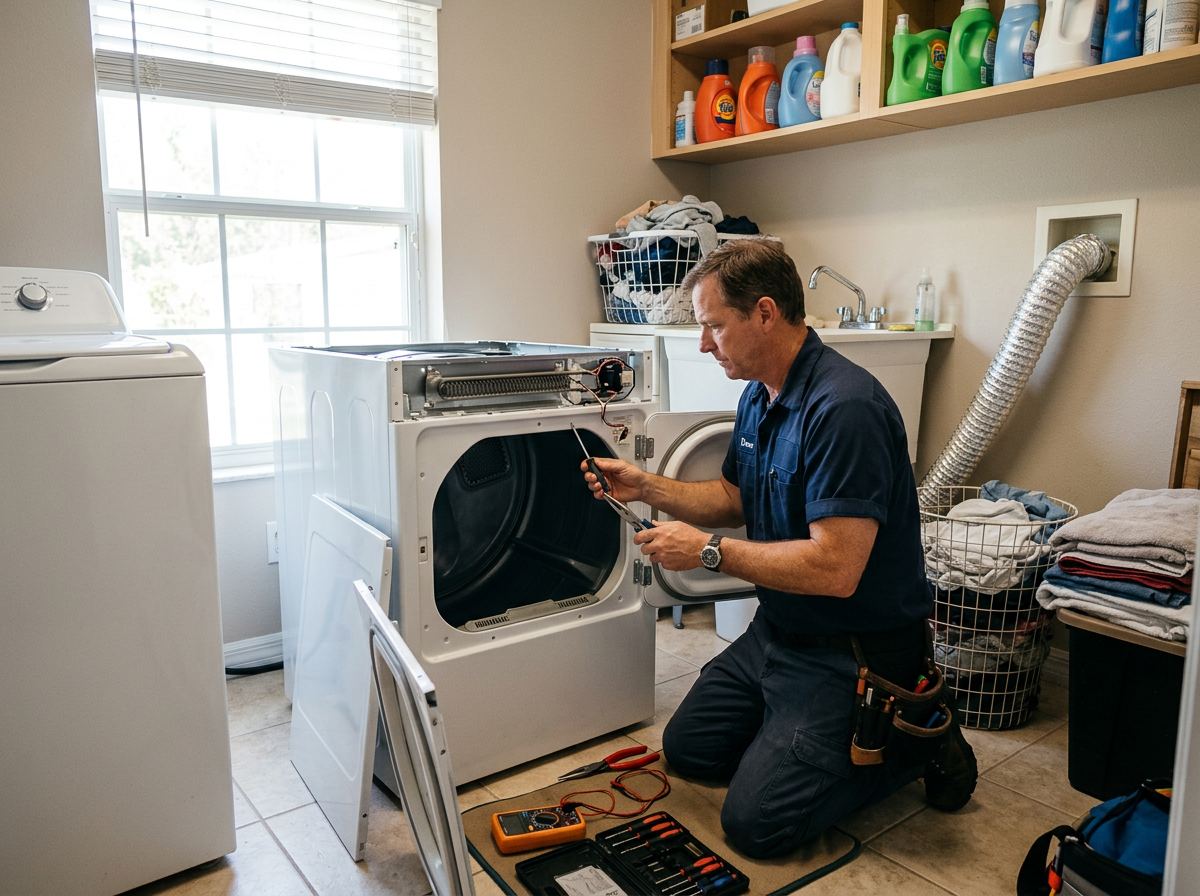
Dryers that take too long usually show clothes still damp after a full cycle, hot exhaust air at the vent, or error codes on the control panel. In block-stucco homes on slabs throughout the Clermont Historic District and Lake Highlands, the most frequent causes are lint-packed roof vents, crushed transition hoses, and failed heating elements or high-limit thermostats. Two-story properties often have extended vent runs that trap moisture during humid subtropical summers, while garage laundry closets add extra humidity that packs lint tighter against the lint screen and rear seals. A visit for this often turns up dryer vent problems and a dryer that runs but does not heat, which we handle too.
We test the heating element for continuity, check the thermal fuse and cycling thermostats with a multimeter, inspect the thermistor and moisture sensor bars for residue, and measure airflow at the roof vent cap. When drive components like the belt, idler pulley, or drum rollers slip, the drum turns too slowly and drying extends dramatically. For electric dryers common in Clermont, we also verify the 240-volt outlet and breaker before any part replacement. Repairs focus on restoring proper heat and airflow without altering gas components in the few propane units we encounter.
Central Florida weather and housing stock create specific patterns. Mild winters reduce natural vent drying, so lint builds faster in long runs from laundry rooms to roof caps. Vacation rentals and stacked units in townhomes near Downtown Clermont often suffer from poor clearance that restricts exhaust. We trace each symptom to the actual failing part rather than guessing, then confirm restored cycle times before leaving the home.
Technician insight
In Clermont, the thing that catches most people out with Dryer Takes Too Long is the long roof-vented runs in two-story block homes. Homeowners often overlook how humidity from Lake Louisa or garage laundry setups lets lint pack tighter in those extended ducts, so the vent looks clear at the dryer but stays restricted at the cap.
Long Vent Run in Lake Highlands Home
A two-story home near Lake Highlands reported 90-minute cycles on towels. We found the roof vent packed with lint after a crushed hose section near the slab. Replacing the heating element alone would not have fixed it. After clearing the full run and installing a new transition hose, normal 45-minute cycles returned.
Dryer Takes Too Long Services We Offer
✓Restricted Vent Cleaning
Clear lint, debris, and crushed sections from roof vents and long transition hoses to restore proper exhaust flow in two-story Clermont homes.
✓Heating Element Replacement
Replace worn or open heating elements that fail to reach full temperature, shortening drying times in electric dryers common across Lake County.
✓Thermostat and Sensor Service
Test and replace high-limit thermostats, cycling thermostats, and thermistors that cause the dryer to overheat or shut off early.
✓Drive Belt and Roller Repair
Inspect and replace slipping drive belts, idler pulleys, and worn drum rollers that slow drum rotation and extend cycle length.
✓Moisture Sensor Bar Cleaning
Clean or replace moisture sensor bars coated with residue so the dryer accurately detects dry loads and ends cycles on time.
How it works
- 1
Symptom Review
We ask about cycle length, heat level, and any error codes while checking the vent location and home layout.
- 2
Component Testing
Using a multimeter we check the heating element, thermostats, thermistor, and drive components for correct operation.
- 3
Airflow and Vent Inspection
We examine the full vent path from the dryer to the roof cap for restrictions and measure exhaust temperature.
- 4
Targeted Repair and Verification
We replace the failing part, clear any lint buildup, then run a test load to confirm normal drying time.